It's Trad, Dad!
Richard Lester's visionary, subversive étude for A Hard Day's Night

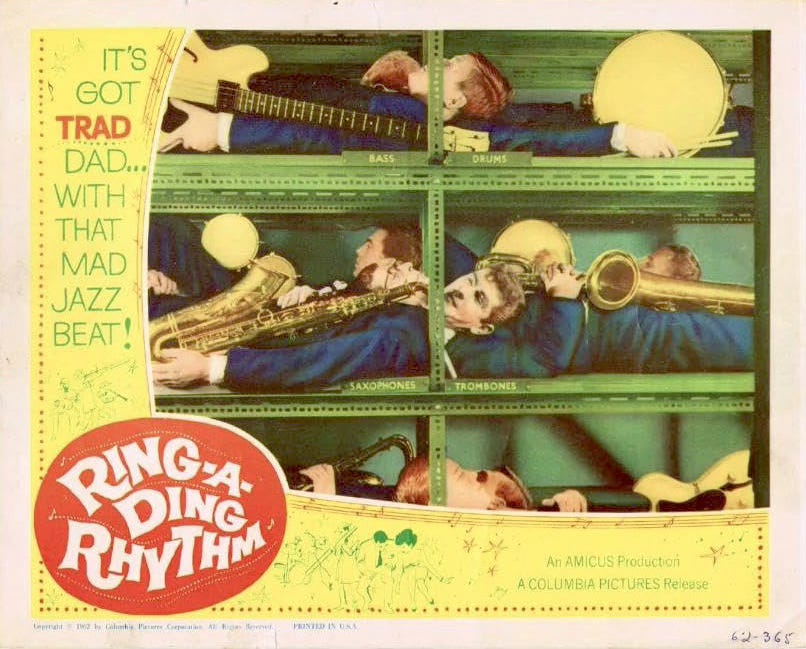
"Can't you do something about this character?" someone says to camera — and a pie flies in from off-screen and hits the offender in the face. A gardener trims the excess lettuce off a sandwich with a pair of hedge clippers. The door to the music department at a TV studio opens to reveal a bunch of startled musicians stacked horizontally on shelves.
These aren't scenes from Monty Python's Flying Circus, which wouldn't premiere for another seven years. Instead, it's the 1962 British teen jukebox musical It's Trad, Dad! — which turns out to be not only a surprisingly visionary memento of an odd, lost chapter in British popular music but also a most unlikely bit of political allegory.
It's Trad, Dad! was made to cash in on the UK's latest teen music craze, which was... 1920s-style Dixieland jazz. You know, like "When the Saints Go Marching In." We're talking clarinets, banjos, trombones, the whole nine, played by white thirtysomething British men who looked like accountants and tried to sing like Louis Armstrong. They renamed it "trad" — short for “traditional,” as opposed to modern styles such as bebop — and from about 1960 to 1962 it was, according to canonical Marxist historian Eric Hobsbawm, "the basic dance-music of British juveniles.” Naturally, this phenomenon cried out for exploitation in a jukebox film, a well-worn genre that had tracked virtually every trend in popular music since the late 1920s, in which a series of musical performances is linked together by the skimpiest of plots.
But why weren't British kids rocking and rolling? Because when It's Trad, Dad!1 premiered in March 1962, virtually all the major rockers were AWOL: Bill Haley, who had originally spread the rock & roll gospel to the UK, was pushing forty and had become old hat; Elvis had gone Hollywood and was busily cranking out a seemingly endless parade of flimsy star vehicles; Little Richard had renounced the devil's music and become a holy roller; Buddy Holly had died in a plane crash; Jerry Lee Lewis had been canceled for marrying his 13-year-old cousin; Chuck Berry was in prison for violating the Mann Act. American kids were rockin’ to the likes of “Pipeline,” “Miserlou” and “Wipeout” but not the British — after all, Nigel don’t surf.
In an attempt to fill the yawning void, the UK music industry flooded the charts with homegrown teen idols like Cliff Richard, Billy Fury and Adam Faith — safe, edgeless pop idols who paled in comparison. But there will always be kids who reject what's spoon-fed to them and instead look for something outside the musical-industrial complex. And those kids landed on trad: unlike manufactured pop, this was organic, acoustic music, and lots of kids already had the instruments — no expensive, hard-to-find electric guitars, amps and drum sets required.
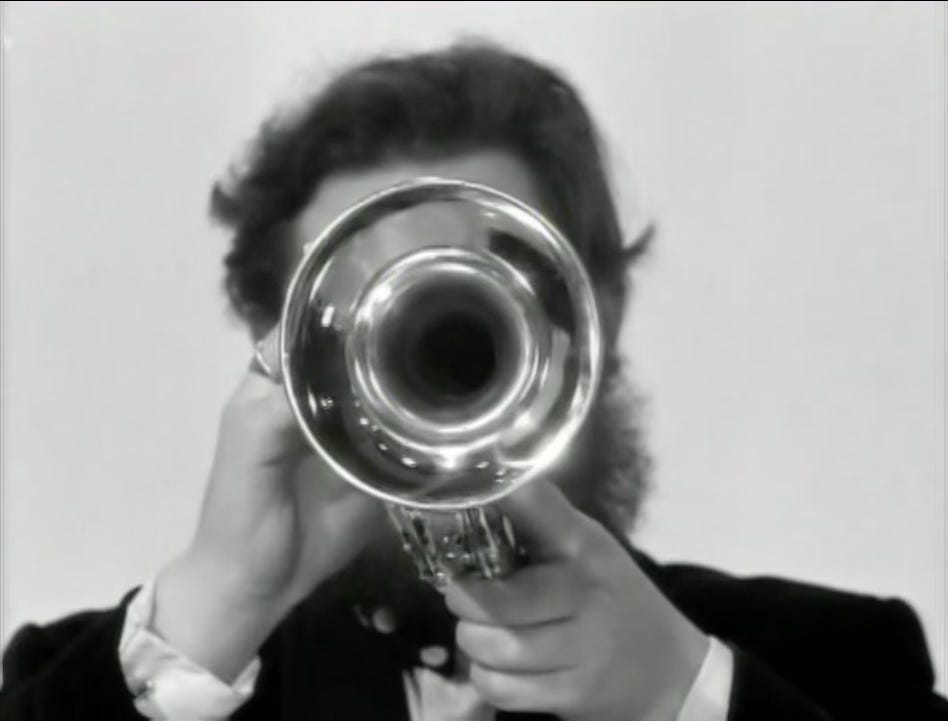
Like rock & roll, trad was upbeat and blues-based, a swingin' antidote to stifling, stiff-upper-lip British culture, perfect for a nation just emerging from severe post-war austerity and full of young people who were yearning to breathe free. The clubs where trad was played live gave kids an organic community they could belong to in a way that manufactured teen idol pop never could. Just as mods, rockers, and punks would later be, trad became a tribe, a subculture.
Trad broke into the mainstream in 1961 when the Sunday morning BBC radio show Easy Beat featured Kenny Ball and His Jazzmen. The kids dug it, and soon Ball had a #2 hit in the UK (and the US) with "Midnight in Moscow."
Being a jukebox film, the artistic bar for It's Trad, Dad! was set pretty low, but the producers hired a very creative and brilliant director: 29-year-old transplanted American Dick Lester, who had never headed up a feature before.
Lester wasn’t some crass American hack. A piano prodigy, he'd graduated from the University of Pennsylvania at the age of 15 with a degree in clinical psychology. More to the point, he'd directed the visionary, absurdist Oscar-nominated 1959 short "The Running Jumping & Standing Still Film," which starred the already legendary British comedians Peter Sellers and Spike Milligan of the influential BBC radio comedy series "The Goon Show." So, even saddled with two bland lead actors and a formulaic, paper-thin script, Lester gleefully loaded It's Trad, Dad! with constant sight gags and intriguing, groundbreaking cinematography, turning what could have been a disposable little bagatelle into an arty, paradigm-shifting work that would set the standard for decades to come.
The plot, such as it is: the stuffy, Churchillian mayor of a suburban English town bans trad jazz, so two teens — played by UK pop stars 15-year-old Helen Shapiro (think a benign Amy Winehouse blessed with an uncanny contralto) and 20-year-old Craig Douglas (all too aptly nicknamed "the Singing Milkman") — spring into action. They go to London to seek out some real-life top BBC DJs and ask them to host a trad jazz festival in their village square so they can prove that trad is good music and not pernicious noise that is surely driving the town's youth to the deepest depths of depravity. The mayor tries to stop the show but (spoiler alert but, let's face it, not really) he fails and the festival is a smashing triumph. The end.
Now, one might wonder: why would the mayor want to ban Dixieland — music that was popular when he was a teen himself? But local councils and the police really did frown on trad jazz clubs, communal spaces that were loud and filled with ragingly hormonal young people who danced deep into the night. And they were well aware that the music had strong progressive political associations — more about that later.
Lester freshened up this time-worn format with some good ol’-fashioned modernism. In just the first 36 seconds of the movie, Lester works in one arty opening visual, two sight gags, a couple of references to the movie's own generic provenance, a sassy poke at adults, and the first of the film's many ruptures of the fourth wall.
Not only was Lester well aware of how formulaic this kind of movie was, but he was also well aware of how well aware his audience was too: they'd seen this same story many times already. So he pokes fun at the patently generic format, naming the two main characters "A Girl" and "A Boy" and setting it in a "new town," the nondescript instant suburbs that sprang up in England after World War II. The town is so nondescript, in fact, that the city limit sign says "WELCOME TO ___________ POPULATION 32462."
When the mayor barges into the café where all the kids hang out and bans trad from the town, A Boy exclaims, "What do we do now?" Out of nowhere, the narrator cheerfully interjects, "He's bound to have an idea, otherwise there's no picture." Right on cue, the background behind them shifts from the suburban café to a London television studio — with the film sprockets showing and everything. "Thank you," A Boy and A Girl say directly to the camera, for they are polite kids. Kitchen sink realism this is not.
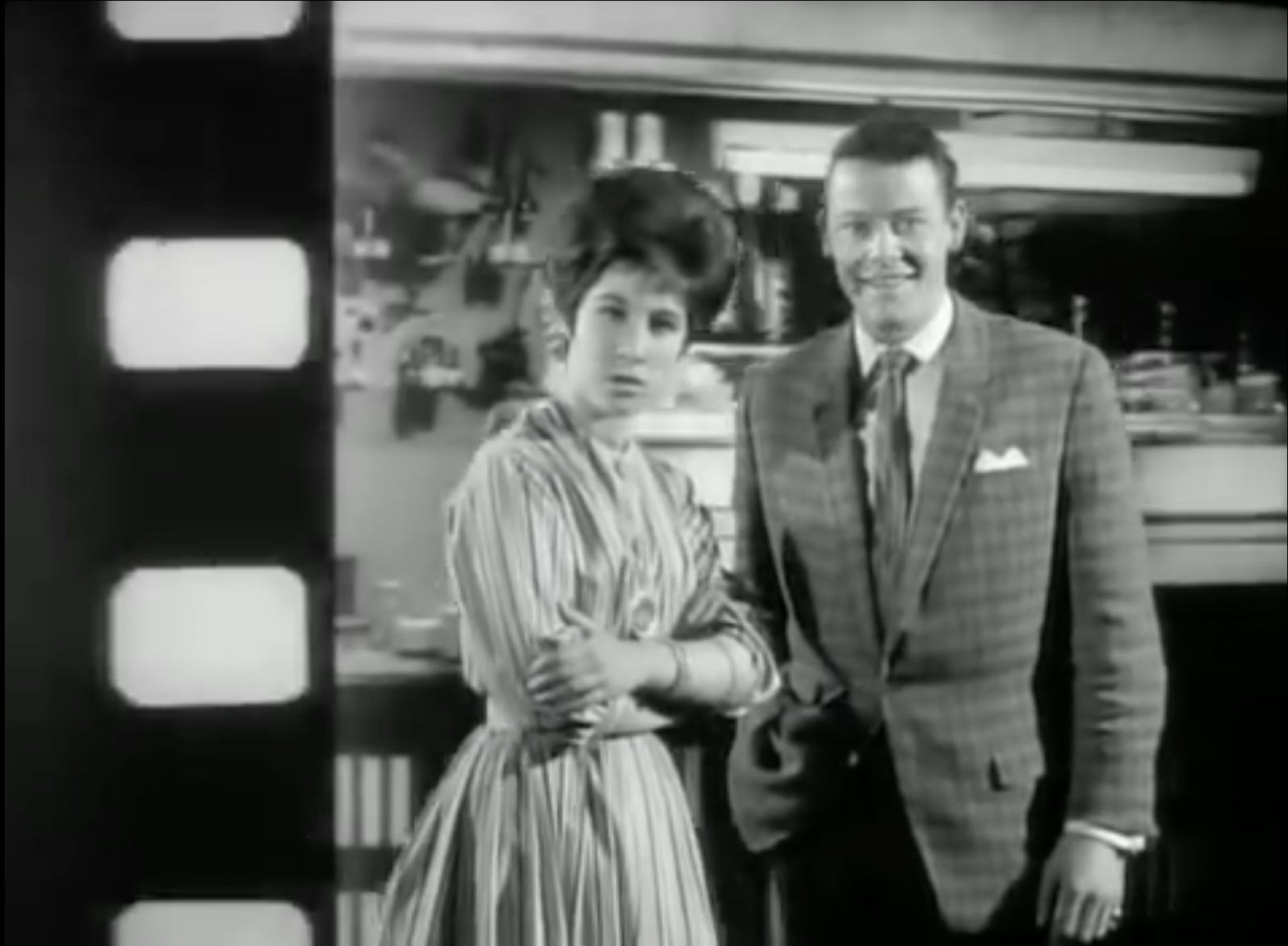
With those and many other self-reflexive touches, It's Trad, Dad! recalls W.C. Fields' gleefully anarchic Never Give a Sucker an Even Break, Preston Sturges' film-about-film Sullivan's Travels and the hyperactive musical comedy Hellzapoppin' (all, oddly enough, released in 1941) but with a quintessentially '60s sensibility borne of TV commercials, pop art and French New Wave films.
It was kind of revolutionary to flatter the intelligence of an audience that wasn't used to having its intelligence flattered. Just as the kids triumph over the grown-ups in the movie, the film's irreverence and invention are a triumph over the condescension of popular culture aimed at teenagers. In its own politely cheeky way, It’s Trad, Dad! manifests the inchoate defiance of early-'60s youth culture.
The heart of It's Trad, Dad! is a Dantean odyssey through the belly of the pop media beast: a TV studio, a nightclub and a recording studio. It's a framing device for what are essentially 26 music videos by most of the major players in the trad jazz scene, including the "Three B’s": bandleaders Chris Barber, Acker Bilk2 and the aforementioned Kenny Ball, as well as a smattering of tame (or, in one instance, tamed) rock and pop artists. Lester makes those performance segments subversive too.
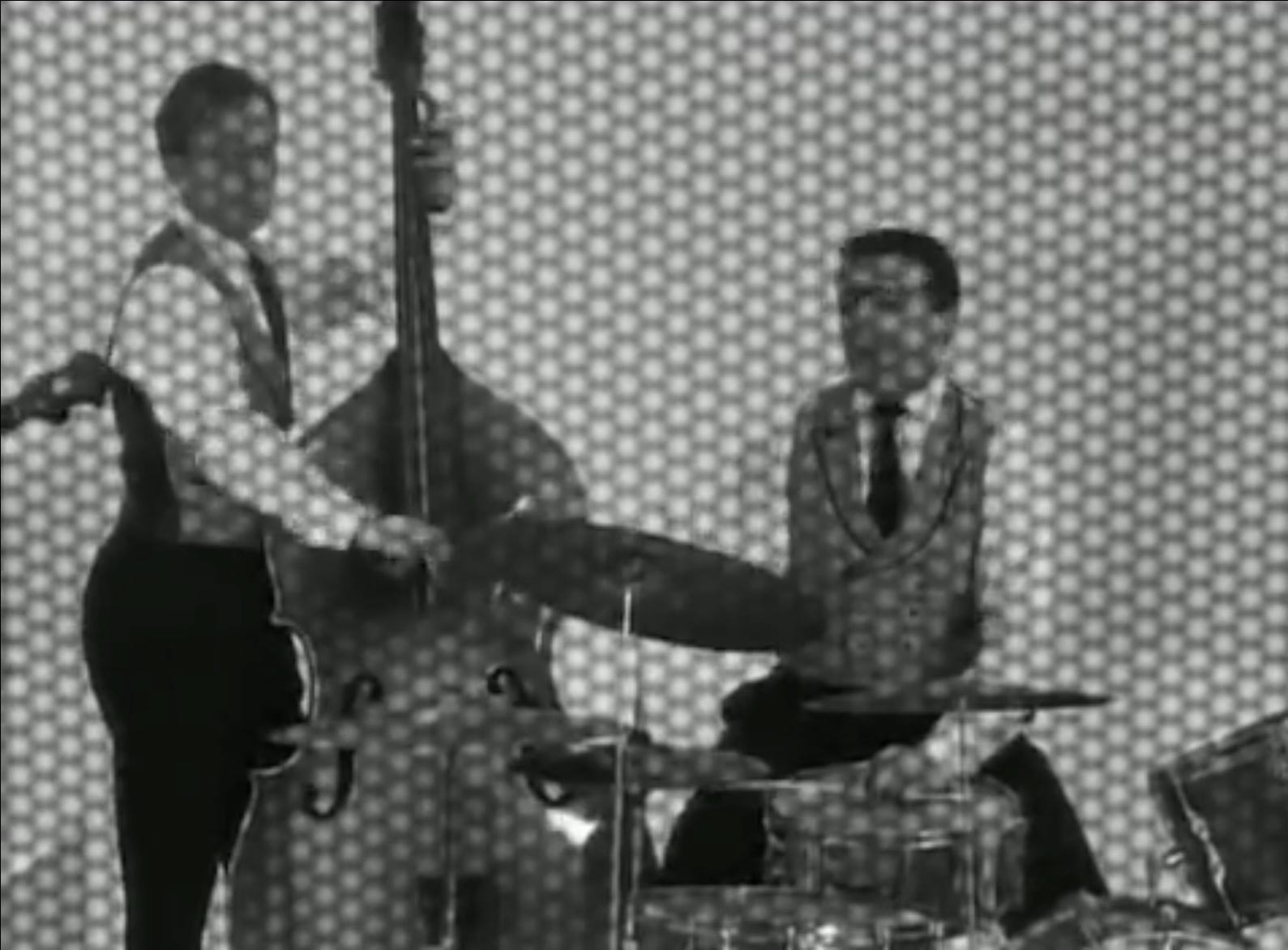
Lester's A Hard Day's Night (1964) routinely gets the credit for innovating quick cutting, unusual angles and multiple cameras for pop and rock performances but it was actually It's Trad, Dad! that introduced those innovations. The music segments feature a cornucopia of daring cinematography3: bizarre camera angles, the singer not in the foreground, masking off sections of the screen, rack focus, ciné-roman-photo (a series of stills that form a narrative, a la La Jetée, which premiered just a month before this movie), shooting in negative, depth of field, overhead shots, close-ups on instruments and musicians, oddball compositions, even filming through a screen that alludes to the Ben Day dots of magnified newsprint — or the kinds of paintings that pop artist Roy Lichtenstein had recently begun making. This was all radical stuff in 1962 — and it still looks arty today.
In his 1962 book Trad Mad, Brian Matthew, host of the BBC's "Trad Fad" show, quotes the show's producer: "I have built a clean, bright set and I want it filled with clean, bright people who enjoy jazz." That's also exactly what Lester does in the TV studio section of the film, but by placing this proudly old-fashioned, unglamorous music and its generally not conventionally attractive players on slick, modernistic sets, presenting them as if they were fabulous pop groups, he wittily spoofs the commercialization of grassroots culture, a rather visionary gesture.
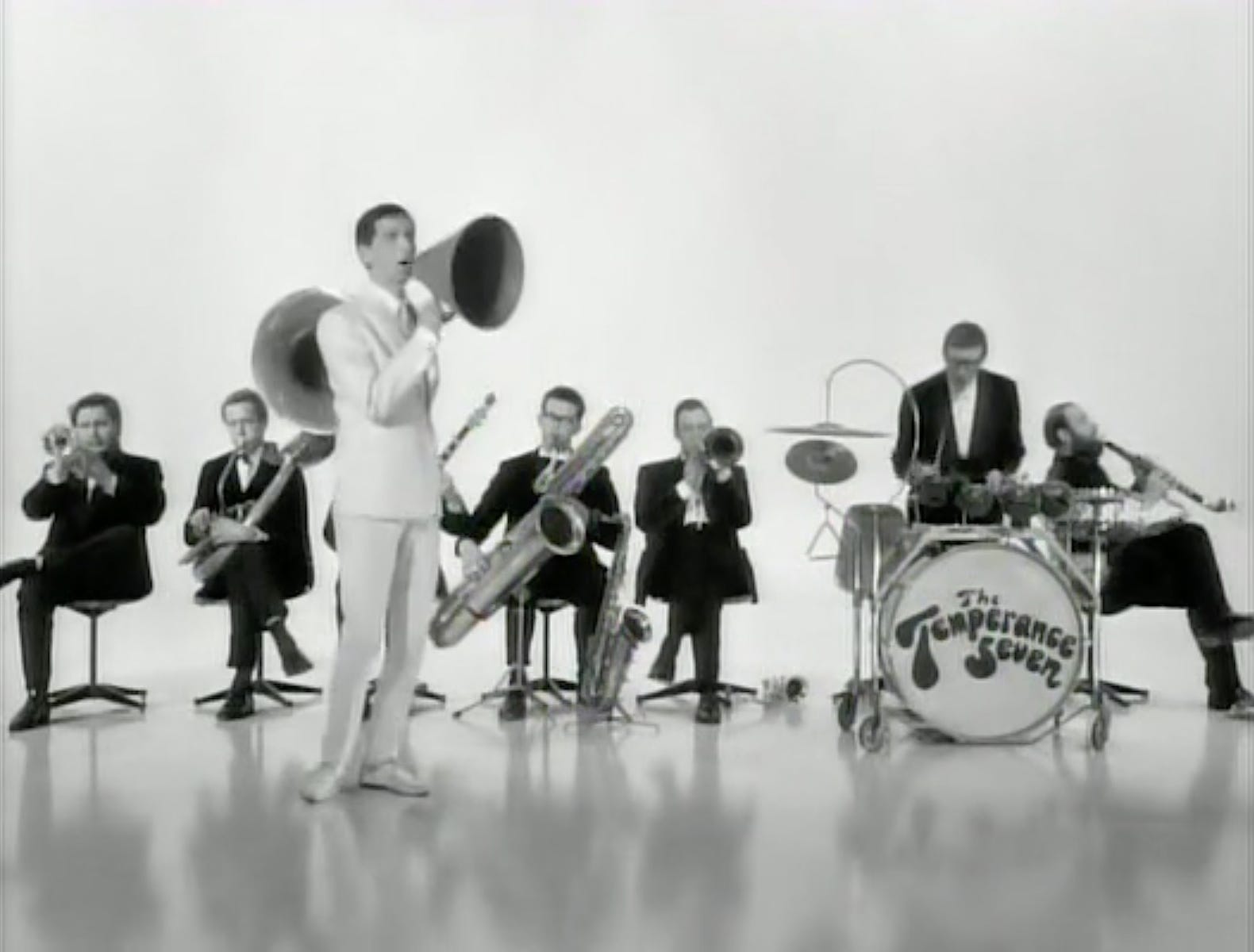
An art school band, the Temperance Seven4 (who were in fact a nonet here) perform on a blinding white set, set in fantastically composed cinematography. When they’re not tooting on their horns, various band members nonchalantly doze, smoke a cigar, check their watch and even enjoy a little lunch as their singer croons in French, "Let's fly to the moon on my raincoat."
Trad fans still listened to pop and rock, so there's star-crossed bad-boy rockabilly legend Gene Vincent all in ironically virginal white, hunched over the microphone stand like a proto-Johnny Rotten, singing "Spaceship to Mars." He seems to float in an antiseptic white purgatory between a saxophone and the neck of a guitar, as if stranded between two poles of popular music. Next, on another minimalist white set, the Brook Brothers sing to blow-ups of their own photographs in a puckish display of pop narcissism; we’re not entirely sure whether they're in on the joke.
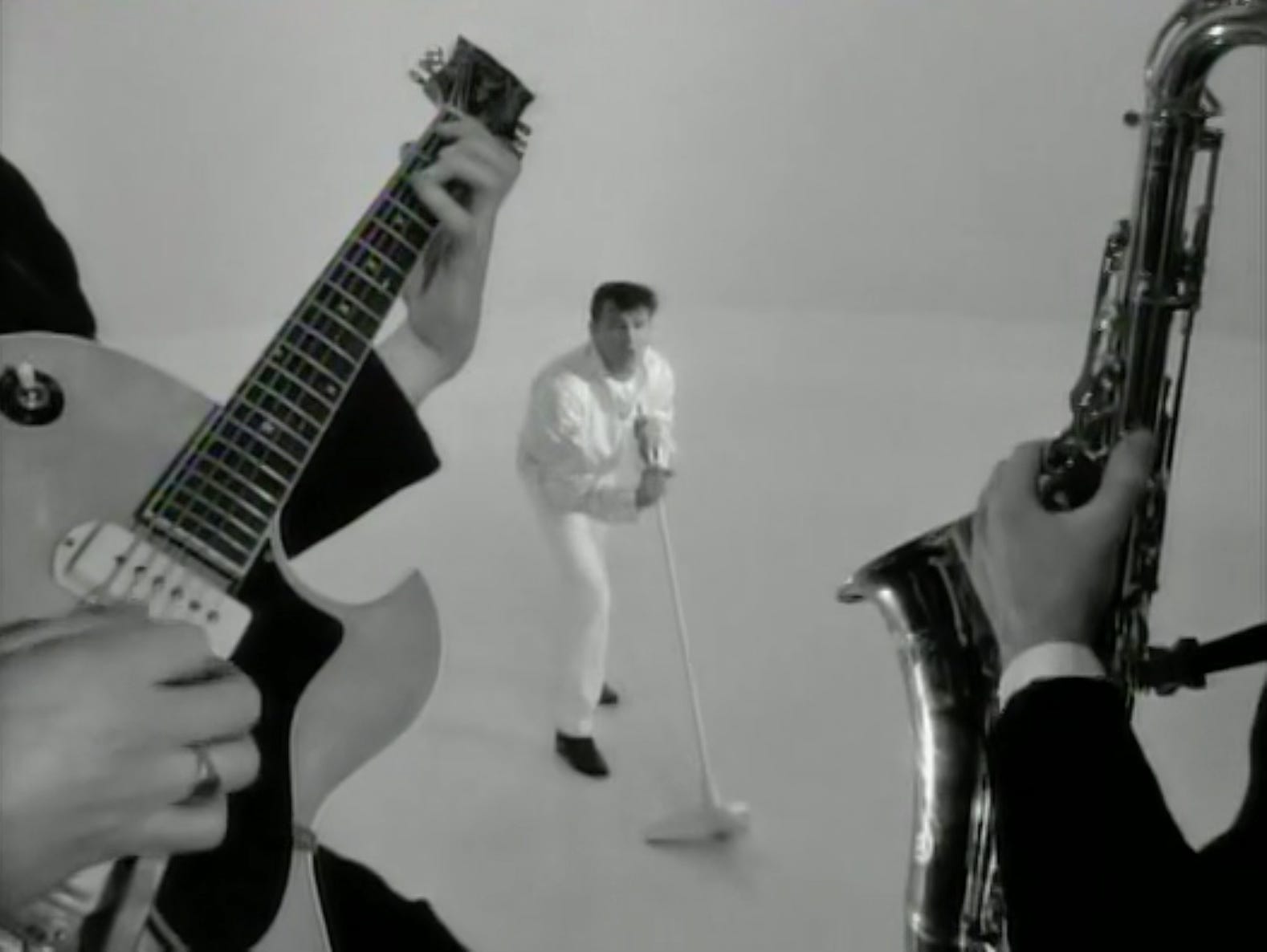
And Lester throws in even more touches that underscore the artifice of it all: he pointedly drops in odd little moments usually spliced out of immaculate pop conceptions, quick, blink-and-you'll-miss-them shots like Acker Bilk's trumpeter wincing when he plays a bum note — something one didn't ever see on camera at the time. At another point, we hear the drummer playing a fancy little fill but there's a very deliberate cut to the drummer very definitely not playing at all. The camera zooms in for deliberately unflattering ultra-close-ups of the sweat on US pop idol Del Shannon's face. British actor-turned-crooner John Leyton sings a syrupy ballad in a shadowy recording studio, polluting his claustrophobic vocal booth with leisurely drags on his cigarette and flipping through the lyric sheet more like a dispassionate newcaster rather than a man cooing in his lover's ear. There's a whole lotta demystification goin' on here.
Trad and a smattering of milquetoast pop were fine for British kids but there was also the US market to think about — the Brits had assimilated Black American music but they hadn't yet figured out how to sell it back to the States, and so American kids neither knew nor cared about sanitized Dixieland. (Which is why the movie was retitled Ring-a-Ding Rhythm! for the US.) So, at the last minute, Lester flew to New York to film a nightclub section featuring some past-their-prime American rock and pop stars, including Chubby Checker, Del Shannon, Gary U.S. Bonds, and Gene McDaniels. The New York performances had to be shot in one day and so are very conventionally staged and feature mostly third-rate material — mediocre interregnum rock like Checker's "Lose-Your-Inhibitions Twist."5
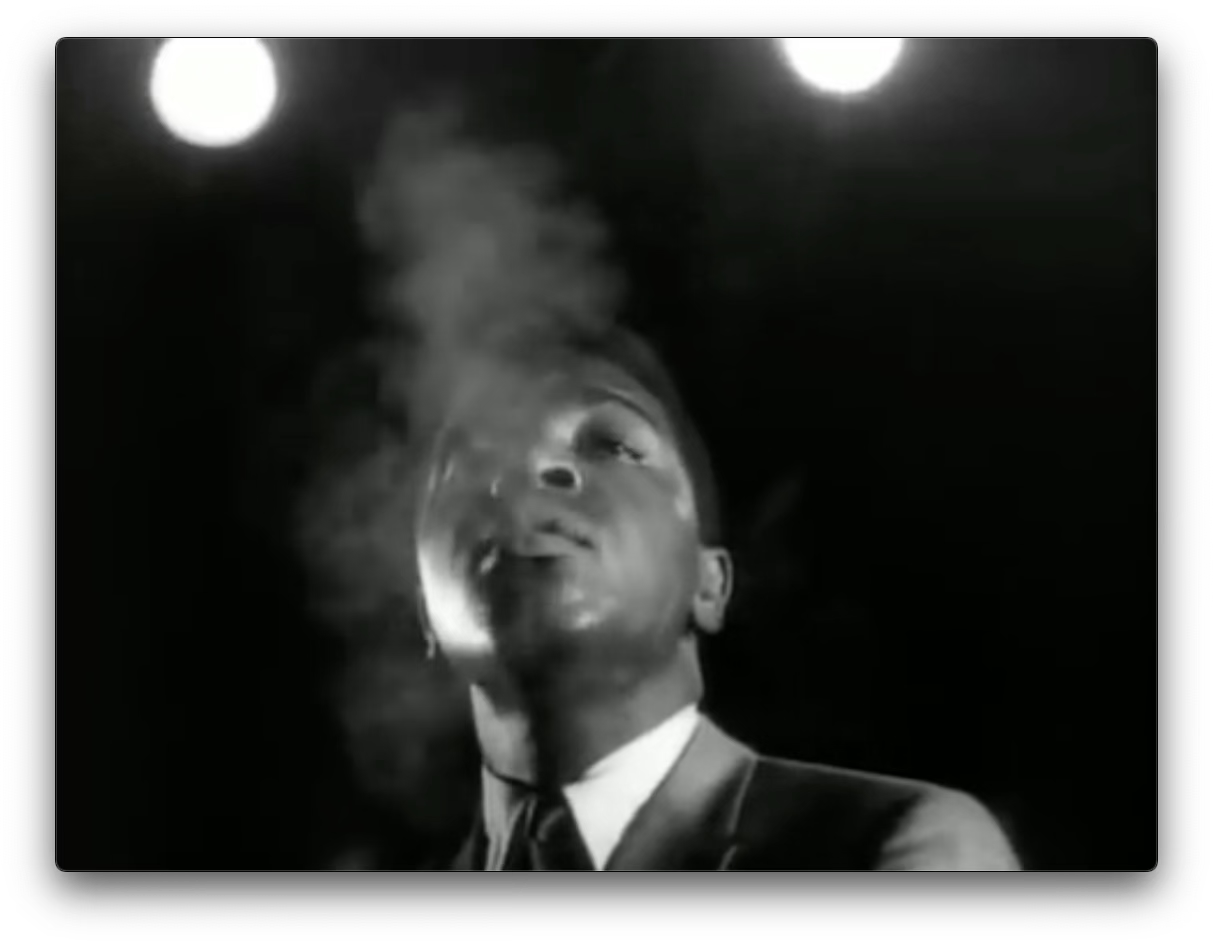
The nightclub passage does feature a couple of heartbreaking highlights. The adorable trio the Paris Sisters, who had hit the previous year with the Phil Spector-produced slow-dance classic "I Love How You Love Me," are back with another Spector gem, the poignant "What Am I to Do?" "What am I to do/Now that we are through/with love?" lead singer Priscilla Paris pleads, with spotlights, ladders and stagehands on the periphery for yet more of the modernist self-reflexive vibe. Gene McDaniels does a devastating take on the Bacharach-David ballad "Another Tear Falls," a moody, emotive number that's almost shockingly morose in the context of such a zany film; McDaniels sits alone in chiaroscuro darkness, cigarette smoke veiling his noble face as he wails pop-operatically, "Just when I think I'm all cried out, another tear falls."6
The film's many formal innovations are fascinating. But what makes It's Trad, Dad! even more subversive is the fact that it’s a stealthy political metaphor.
There’s a reason why It’s Trad, Dad! features more beatnik-style goatees than a Robin Hood movie: before the music trickled down to teens, the first trad fans were art‑school types (i.e., hipsters) and left‑leaning activists, lending the music a bohemian, intellectual cachet. With its freewheeling improvisatory nature, roots in Black American music and ostensibly dim commercial prospects, trad resonated with a broader anti‑establishment ethos that blossomed amidst the stifling conformity of Cold War-era Britain. It was, as Eric Hobsbawm put it, "people's music."
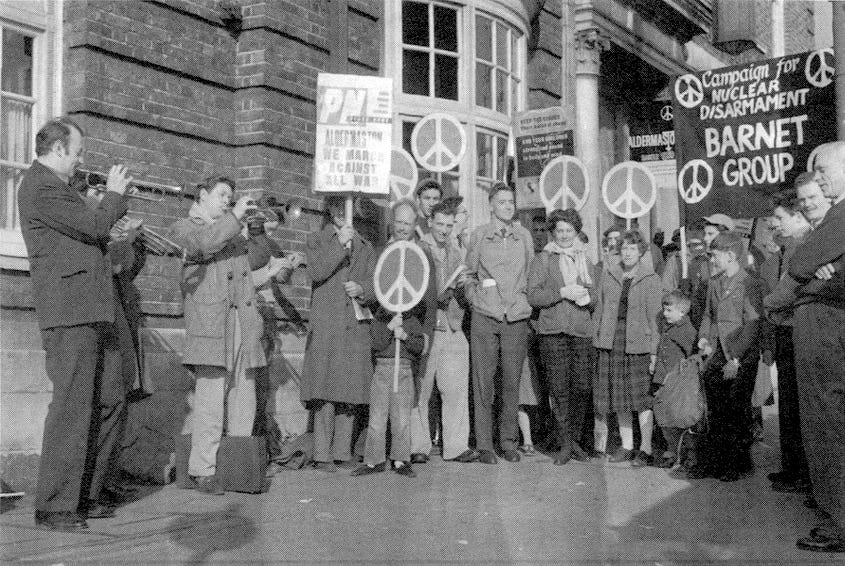
So it's no coincidence that trad was closely associated with progressive populist politics, especially the Campaign for Nuclear Disarmament7, better known as the CND, the flagship organization of a very popular UK movement to ban the Bomb. One could find CND leaflets and badges at trad jazz shows, and trad jazz bands such as the Omega Brass Band and the Alberts played in the CND's annual Easter weekend Aldermaston marches, major anti-nuclear demonstrations in which thousands of people walked from London's Trafalgar Square to Aldermaston, site of the Atomic Weapons Research Establishment facility.
And what better way to protest the most lethal weapon human beings have ever devised than with festive, life-affirming music. "Gaiety is part of this thing too," says the narrator of the famous 1958 documentary March to Aldermaston — who was none other than Sir Richard Burton — as trad tootles along on the soundtrack. "It's no use being against death if you don't know how to enjoy life while you've got it." Trad jazz turned Aldermaston into the world's longest second line, propelling tens of thousands of marchers through 52 miles, four days and the occasional drenching British spring rain.8
And that all figures in the finale of It's Trad, Dad! Thanks to their determination, resourcefulness and the very righteousness of their cause, the kids get their trad jazz festival. And not for lack of heavy-handed resistance from the authorities: the bands overcome two military-style police roadblocks to get there. The symbolism is clear: the Establishment is oppressive and out of touch, and collective action can defeat it. It's a glimmer of the emerging demographic might of the boomers, who were just beginning to understand themselves as a political force — even if their politics were still being expressed more through music, fashion, and generational rebellion than any explicit ideology. That would explode over the rest of the decade.
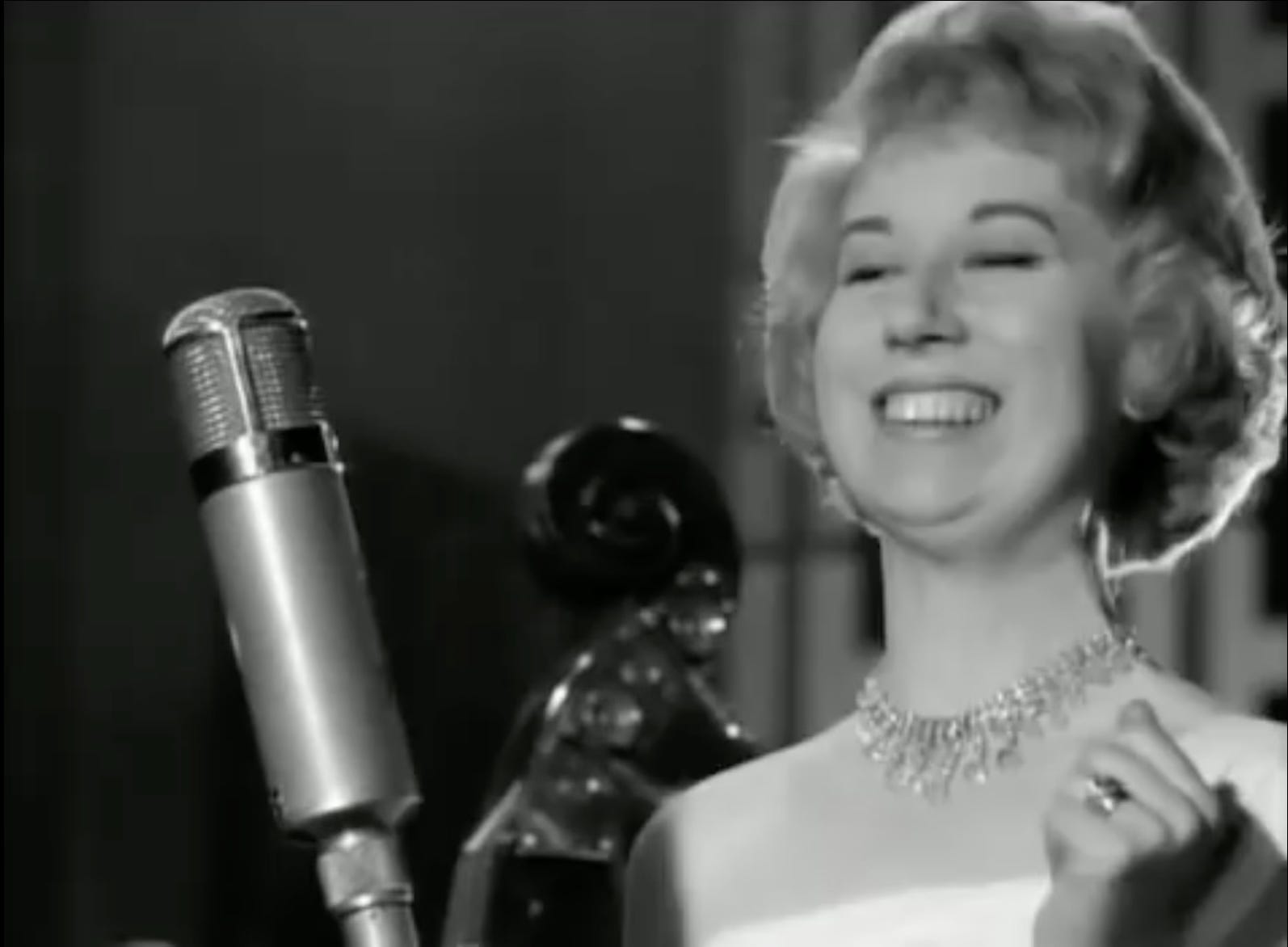
And then Lester really lays it on. When the bands arrive at the festival, Chris Barber's Jazz Band busts out what to American ears might sound like a Dixieland version of "O Tannenbaum." But it's actually "The Red Flag," the anthem of the British Labour Party, which supported nuclear disarmament. Then they accompany the splendid Northern Irish blueswoman Ottilie Patterson, who belts out a swingin' version of the antebellum African American spiritual "Down by the Riverside," pointedly repeating the song's immortal line "Ain’t gonna study war no more" no less than nine times in under two minutes. Then it’s “When the Saints Go Marching In” — a truly apocalyptic song when you think about it — which progressive Brits would immediately have recognized as a staple of the Aldermaston marches. And with that, It's Trad, Dad! becomes a defiant progressive political statement9 — for those with eyes to see it and ears to hear it. Not bad for a flimsy little teen jukebox musical.10
For all its charms, innovations and unexpected depth, It's Trad, Dad! dudded — in popular culture, timing is everything, and trad was on its way down. But after that, Lester scored a modest hit with a more overtly political and yet no less whimsical film, the Cold War satire The Mouse on the Moon (1963). Then, a big break. Red-hot Liverpudlian beat combo the Beatles were looking for someone to direct their first feature film. But, as John Lennon has been quoted as saying, “We weren’t interested in being stuck in one of those typical nobody-understands-our-music plots where the local dignitaries are trying to ban something as terrible as the Saturday Night Hop” — which is pretty much the synopsis of It’s Trad, Dad! The Fabs, though, loved “The Running Jumping & Standing Still Film.” Dick Lester got the gig.
In retrospect, It's Trad, Dad! is an étude for A Hard Day's Night, and the many similarities between the two movies are another great reason to watch it: they're both mad dashes through what Joni Mitchell would later call "the starmaker machinery behind the popular song," with slender plot lines redeemed by sight gags, modernistic aseptic white studio sets, occasional breaks in the fourth wall, generational clashes, Pop Art allusions, a winking irreverence for authority, and even a fussy TV director in a fuzzy sweater, all handsomely and inventively photographed in glorious black-and-white.
With A Hard Day's Night, Lester once again showed his audience how the pop culture sausage is made. And once again, what could have been a lazy, by-the-numbers cash-in became something both arty and cheeky — not to mention one of the greatest film comedies by any measure. The two movies would make a very enlightening double feature.
The “Dad” in the title wasn’t a reference to someone’s father, it was beatnik slang meaning basically the same thing as today’s “dude.”
Later in 1962, Bilk starred in the b-movie Den of Thieves, in which Bilk’s band moonlights as a high-end burglary ring.
Major props to cinematographer Gilbert Taylor, who went on to shoot not only A Hard Day’s Night but Stanley Kubrick’s canonical Dr. Strangelove (1965), Roman Polanski’s epochal Repulsion (1965), and various early episodes of The Avengers, the mega-stylish British ‘60s TV series.
The Temperance Seven had notched a #1 UK hit the previous year with a self-consciously retro cover of the 1930 jazz hit “You’re Driving Me Crazy,” produced by EMI staffer George Martin.
“Hey, girl, lеt’s swirl/ Baby, sky-high we go/ Hey, child, go wild/ Throw away your ego”
McDaniels had a great second act: he wrote the 1969 jazz-soul protest classic “Compared to What” and Roberta Flack’s sublime 1974 #1 hit “Feel Like Makin’ Love.”
Fun fact: the now universally recognized peace symbol originated as the logo of the Campaign for Nuclear Disarmament.
The CND believed that protest should have a component of fun, a quality that the Yippies wholeheartedly embraced a few short years later. And that idea continued to reverberate in the counterculture: in 1985, the brilliant mythologist Joseph Campbell declared, “The Deadheads are doing the dance of life — and this, I would say, is the answer to the atom bomb.”
Although the ending, with the jowly mayor happily dancing to the music and taking the credit for the festival’s success, might also hint at how grassroots movements are often co-opted by the establishment — just as trad was.
The producers followed up It’s Trad Dad! with 1963’s Just for Fun, an inferior, Lester-less carbon copy of the earlier film but with no trad — which had become passé, UK teens having been transfigured by the Beatles’ “Please Please Me” — and with the political angle bizarrely ginned up: the Conservative and Labour parties infiltrate the Teenage Party (their spy is played by Jeremy Lloyd, who would soon pogo in a nightclub with Ringo in A Hard Day’s Night) in an effort to derail the kids’ quest to run the United Kingdom. Spoiler alert: they fail.
Terrific piece, Michael. I was not familiar with this movie and sorta wished I had known about it before I finished my book on Jeff Beck (he was a Gene Vincent fanatic, so I’m sure he saw it). I do talk about the huge impact of "The Girl Can't Help It" on Beck. While the script is pretty idiotic, the performances are great and director Frank Tashlin (famous for his work on Looney Tunes) provides a great manic visual flair. Certainly not as sophisticated as Lester, but it's definitely a precursor.
Great piece. For years, my Yankee ass couldn't figure out why in the world Acker $#&@ Bilk and Chris Barber were practically the equivalent of rock and roll stars in that era. The film didn't clarify much for me, but I did appreciate the passion behind the music. (Acker Bilk is still shite, though.)