Silver Bells: Communing with Phil Kline's "Unsilent Night"

    "Unsilent Night" is perhaps noted new music composer Phil Kline's greatest hit.  And like all truly great hits, it's taken on resonances that perhaps its creator never quite anticipated.
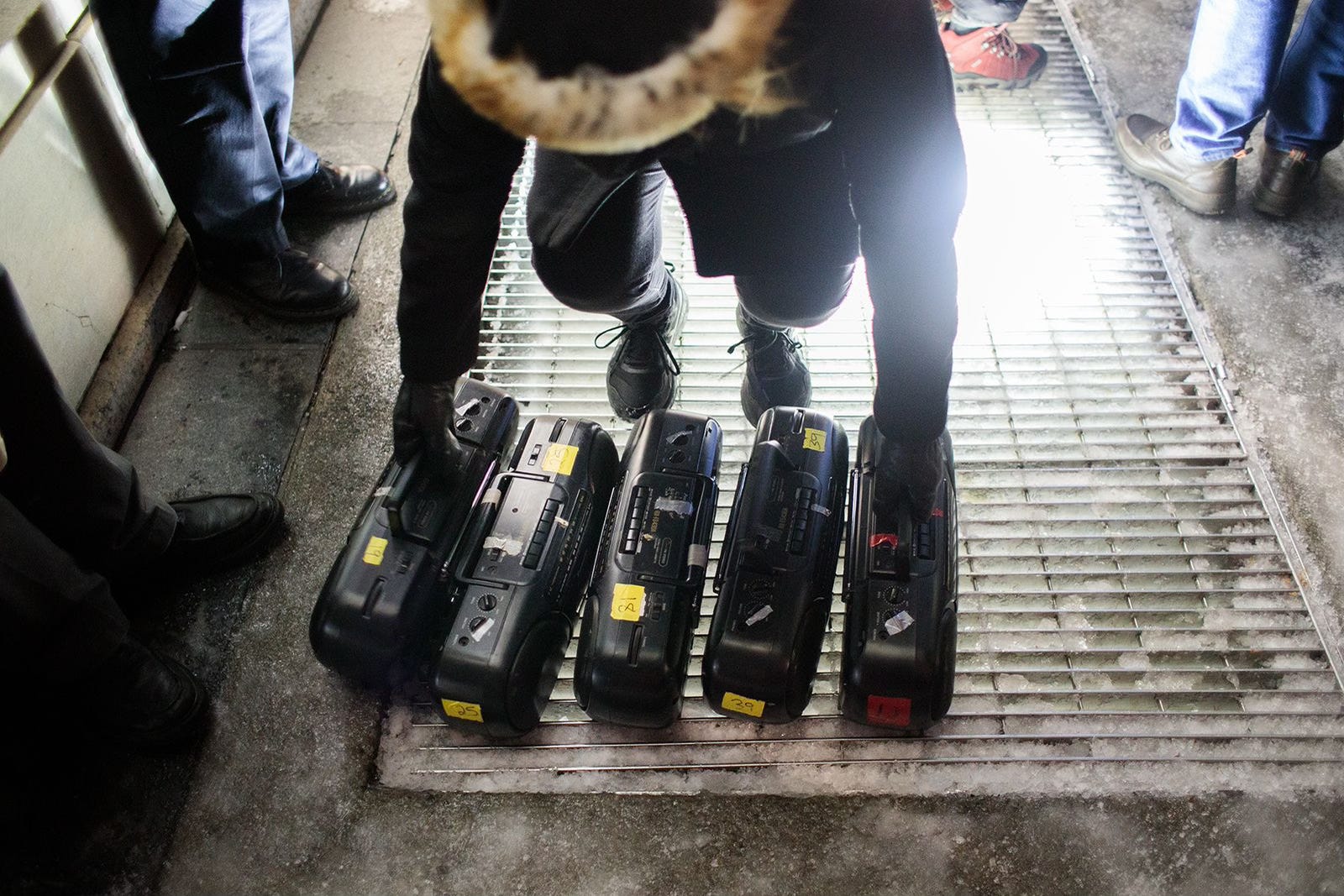
    It started in 1992, when Kline envisioned "a public artwork in the form of a holiday caroling party" — but without the singing.  So he composed a four-channel electro-acoustic piece that was a little under 45 minutes long — because that was the length of one side of a C-90 cassette tape — and then, that December, invited a bunch of friends to help him debut it on the streets of Greenwich Village.  The New York Times and The New Yorker both listed the event and about 75 people showed up.  Kline handed out a bunch of portable cassette players, each with one of four tapes in it, and told everybody to press play simultaneously.  Then they started walking.  "In effect," Kline has said, "we became a city-block-long stereo system."
    Kline decided to make it an annual event — and over the next 33 years, that city-block-long stereo system became several city blocks long, with hundreds of participants every year, and "Unsilent Night" has spread to 175 cities on five continents.
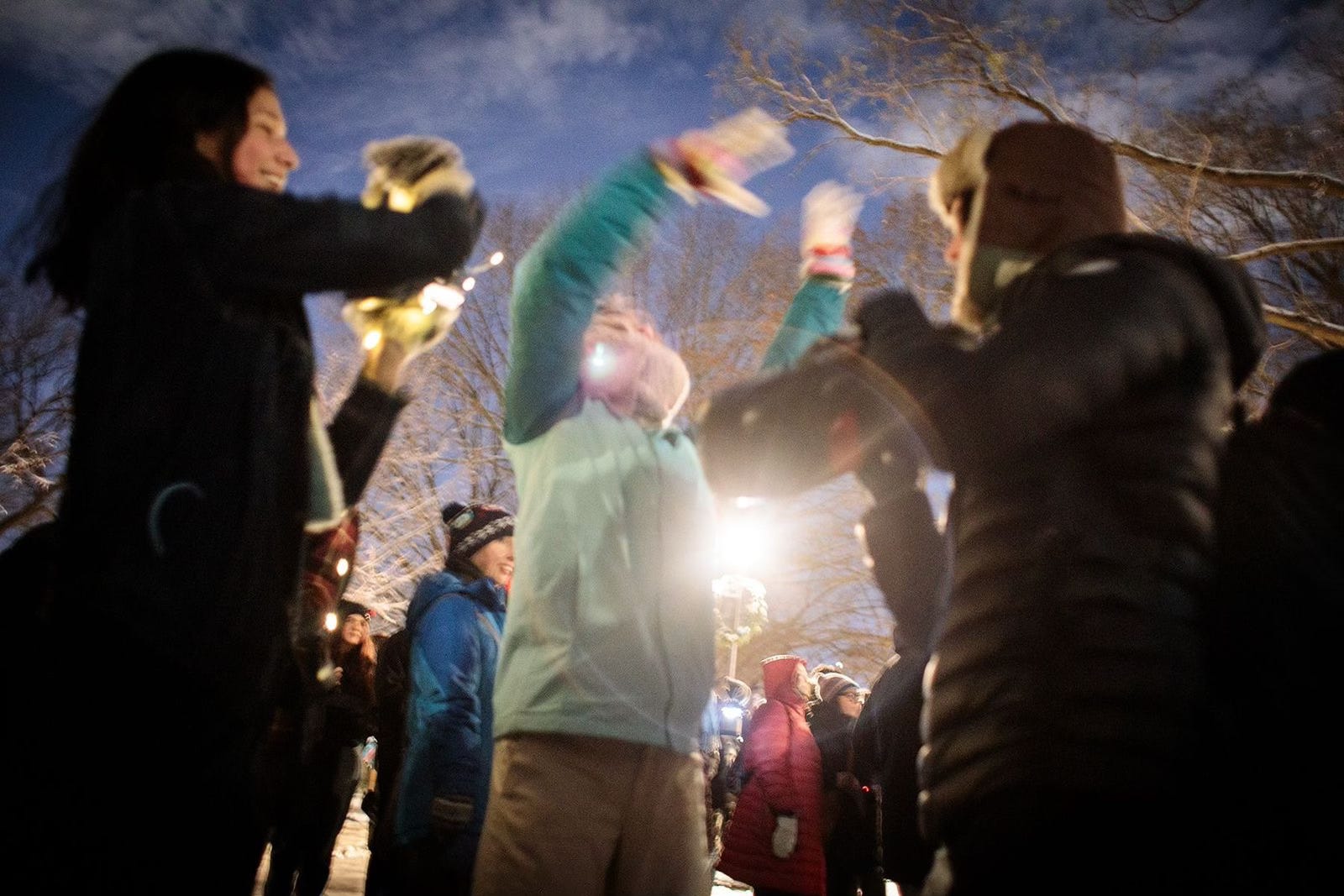
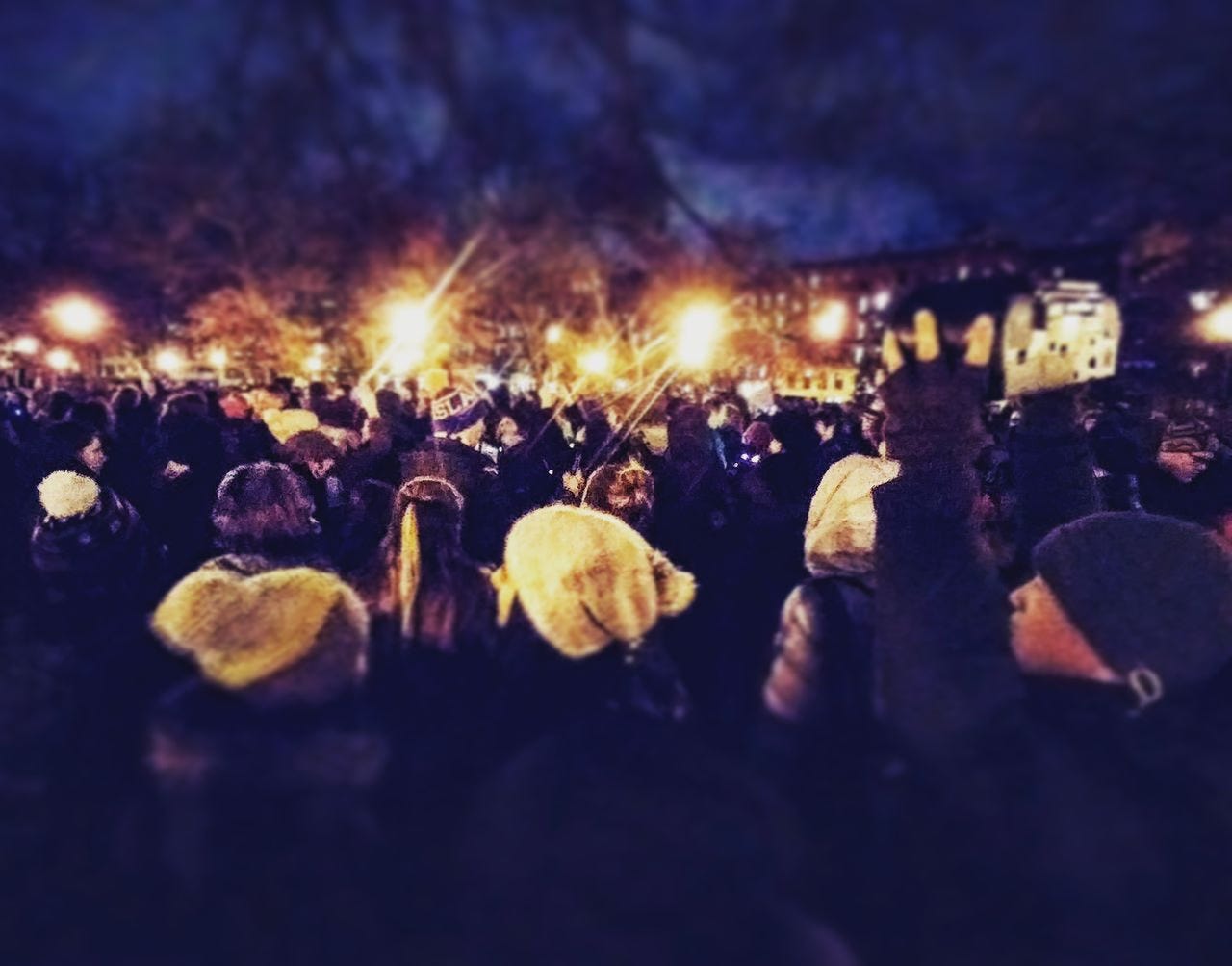
    In Manhattan, the piece begins at the famous arch in Washington Square Park on the second Sunday of December.  The crowd gathers at 6:00 in the evening, with a lucky few early birds snagging one of Kline's dwindling collection of working boomboxes; many use the "Unsilent Night" app to play a randomly selected track through a bluetooth speaker, and some are just along for the walk.  As she has since she was a little girl, Kline's now college-age daughter Clementine gives the instructions through a megaphone and then Kline himself leads the procession east through the park, around the fountain, through the NYU campus and across the East Village to the final destination, Tompkins Square Park.  It's the same route every year, partly for the sheer ritual of it but mostly so Kline can time the march so everyone is in the park for the finale, a sublime, lambent passage aptly titled "Angels of Avenue A."
    It's normally an 18-minute walk from Washington Square Park to Tompkins Square Park, but the "Unsilent Night" procession takes 43 minutes — it's a leisurely stroll, literally a change of pace from the usual New York hustle.  And that creates a social space, a chance to bump into old friends, make new acquaintances and chit-chat with strangers about the cool speaker they made out of a piece of sheet metal.
    Kline has called the piece "a public sound sculpture," and if you're part of the procession, there really is a vivid spatial, even tactile, sense to the music, a unique quadrophonic surround effect coming from the dozens of speakers all around you.  Every December, as I walk amid the tintinnabulation, I'm reminded of these lines from '60s folk icon Phil Ochs' song "The Bells": "How they tinkle, tinkle, tinkle in the icy air of night/All the heavens seem to twinkle with a crystalline delight."  It's kind of magical, this murmuration of Tinkerbells.
    A lot of "Unsilent Night" is a sort of enchanted music of the spheres: what sound like tubular bells, cowbells, steel drums, and pointillistic chimes all ricochet around cold, hard city streets.  Somewhere around 2nd Avenue, there's an interlude of long, reverberant choral voices and then back to a rippling tapestry of sampled church bells.  At Tompkins Square Park, a sound like celestial steel drums with choir builds to a finale and then gently fades away; it's always fun to hear the last few speakers still going, stragglers who pressed play a little late.  And then, always, every year, applause — applause for the piece, applause for Phil Kline, applause for each other.
    "Unsilent Night" is a kind of mass performance art by people who might not usually perform.  The folks toting the boomboxes and bluetooth speakers are each other's audience but, as with any performance, a big part of the fun is the feedback from the crowd: the people on the street who express amazement, amusement or bafflement as they get swallowed up in the procession, the drivers who stop and wait for this entire euphonious parade to cross the street, the folks who lean out their window to see what the hell is going on.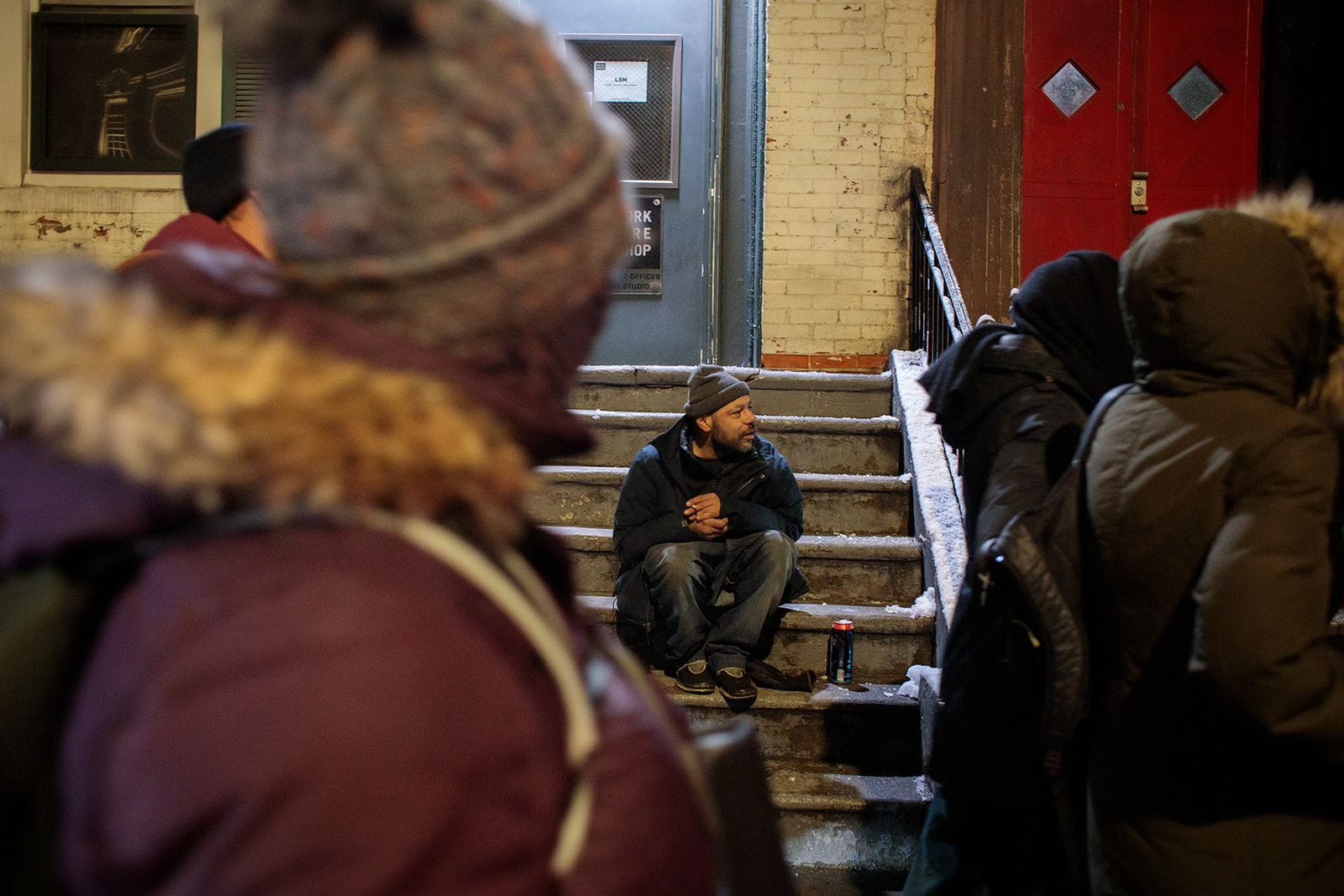
    It reminds me of another mass performance art piece: flash mobs.  In 2003, large crowds of people would materialize around Manhattan and worship a gigantic animatronic T. rex in the Times Square Toys R Us or line up around St. Patrick's Cathedral and tell curious passersby that they were waiting for Strokes tickets.  It was wholesale absurdism.  But, like so many inventions, flash mobs had an interesting knock-on effect.  This was still in the wake of 9/11, and a jolly group of people peaceably assembling felt like a way of asserting some of the freedoms that were eroding before our eyes.  It reclaimed the idea that people are basically good, that they could plot and conspire not to do evil but to do something fun.
    "Unsilent Night" is a benevolent conspiracy too.  As we're increasingly alienated from each other by our phones, by divisive media and by malevolent politicians, a general decline in socialization pervades our culture.  It's gotten to the point where many people choose self-checkout so they don't have to make small-talk with cashiers.  But we are literally social animals: face-to-face human interaction is essential for our psychological wellbeing.  So gathering with a crowd of people to do something sweet and magical isn't just pleasant — it's a small-p political act.
    Appropriately for the season, "Unsilent Night" reminds that people can assemble in peace, for a little social communion, for the simple human pleasure of being in the same place at the same time as other people — and sharing a little joyful noise.
    To see if there's an "Unsilent Night" happening in your town, visit the website in early December.  I'll remind you.